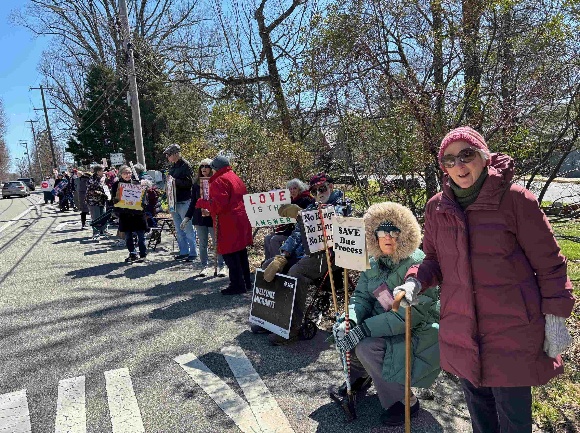
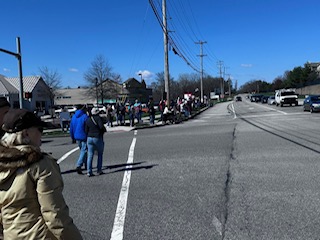
The founding principle of Senior Citizens for America is that we seniors were bequeathed, and flourished under, a system of representative democracy, and that we feel compelled to pass on that bequest to the generations of Americans which follow us. We see that obligation as our principal political purpose. But many of us who have participated in the No Kings rallies have noticed that gray-haired citizens seem to far outnumber younger participants. Why is that?
One possibility is that our observations are not an accurate description of younger voter interest and participation in the anti-authoritarian movement. According to AI, no one thus far has done a demographic study of the participants in the rallies. So anecdotal evidence will have to suffice, and if there is a problem with younger voter engagement, we need to know it sooner rather than later.
According to various sources I’ve consulted, which consist of online research, discussion with a professor of political science, and my grandchildren, here is what I have learned.
The most concerning reaction came from two of my grandchildren. One is a recent graduate of Vasser. When I described to him the mission of Senior Citizens for America, i.e., that we seniors were blessed to have received from our predecessors our system of government, and feel compelled to protect it and pass it on, his reaction was that his generation does not feel that this system has been a blessing. Another grandchild, a graduate of Cornell, agreed that the present system has not worked well for her generation. She suggested that many of her friends are interested in specific changes, such as those suggested by the new mayor of New York, but that others might want to try some new and different form of government, although she did not know what that form might be.
If this is a common opinion among young voters, SCFA’s basic premise will not appeal to that generation. Unfortunately, there is good reason to believe that it is common opinion. We know that discontent with liberal democracy is not limited to the United States. Throughout the democratic world there has been a populist move away from democracy and toward authoritarianism. Particularly in countries which never experienced authoritarian government, such as America, the population may be tempted to give authoritarianism a try, not appreciating that once you give up your political power, it is not easy to recover. We should not abandon our founding principle, but we probably need to add to it, to make clear that we do not want just to preserve our democracy, we also want to improve it.
On the other hand, presence at No Kings rallies may not be a reliable measure of the interest and involvement of younger Americans in the anti-authoritarian movement. Many of us grew up in the 1960s. Public protests come naturally to us. The younger generation may not have confidence that such public protests accomplish anything, and may view them as simply “performative.” But they may not be uninvolved; they’re just involved in a different way. They rely on social media, and that is where they share opinions and organize. This undoubtedly is true for a significant number of younger voters. SCFA is sensitive to that fact, and presently is investigating how we might use social media to get our messages to a larger audience.
Finally, most of us essentially believe in our government and public institutions. We just think they have been undermined and distorted, and need to be restored. There is some evidence that younger people feel differently. They do not have confidence in the institutions at all. They are less interested in general principles, such as “save democracy,” than they are in specific policies. They care about a woman’s freedom of choice, LGBTQ rights, ICE conduct, affordability, and other specific issues. If this is the case, it raises an important question for SCFA. Many of us share views on specific issues, but SCFA was formed particularly to defeat a broad idea – authoritarianism. If we want to attract certain portions of the population, perhaps particularly young voters, however, we will have to consider whether to expand our platform to include positions on specific issues.
If we are to succeed at our mission, we need to understand the barriers to our success, and to take steps to overcome them. That it what we are continuing to do, and we are grateful for whatever thoughts you, our subscribers, have to help us achieve that goal.
****************
A few statistics from the Pew Research Center and the Pew-Knight Initiative
It probably won’t surprise anyone to learn that the 43.9% voting rate of 18-24 year olds in the most recent presidential election (2024) was substantially lower than the 71.7% voting rate of those 65 and older. However, it might be a surprise to discover than the respective voting rates in the preceding congressional election year, 2022, were not just different but overwhelmingly different, 25.6% v. 64.6%. Older people voted in that election at a ratio of almost 2 1/2 to 1 relative to the younger cohort.
According to a report from the Pew-Knight Initiative entitled “Young Adults and the Future of News”, another stark difference between younger and older adults is in the percentages of the two cohorts who generally follow the news. In the case of older adults, it’s 62%. For the younger cohort, it’s only 15%. (Notably, when they are looking for news, 76% of younger adults find it on social media, with about half of these getting it from “news influencers”.) The report goes on to say that younger adults are less likely to feel attached to their communities than older adults are. In addition, although all of us may find the news unsettling, younger adults are particularly prone to being upset by it. 33% of young adults reported feeling scared and confused by the news “often or extremely often.”
****************
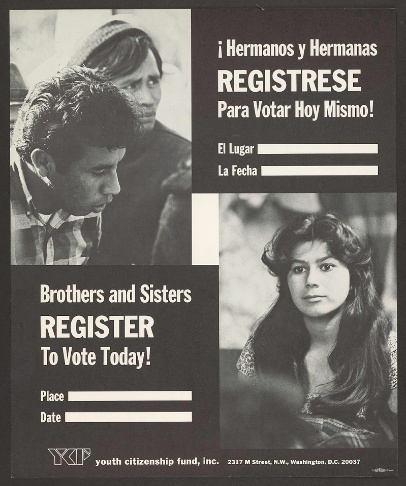
(A poster from the 1970’s prepared by the Youth Citizenship Fund, Inc. Image courtesy of Wikimedia Commons.)
Now, some questions for your consideration!
Have you ever had a conversation with your grandchildren (or other young people) about the subject of democracy?
If they are old enough to vote, have they registered and voted in an election?
What issues do they seem to care most about?
Have they expressed to you any opinion about the importance or lack of importance of voting? Do they think it makes any difference?
Have they experienced any civic education courses in their school this year? Any other year?
Do you think that they have been adequately prepared by their school(s) to exercise their rights as citizens?
Would you like to see more attention paid to civic education and, if so, what would you recommend?
We would love to have your feedback. Please send us your thoughts on these questions or any related subjects either by going to our website and navigate to Contact Us) or by sending us an email at seniorcitizensforamerica@gmail.com. Thanks!