
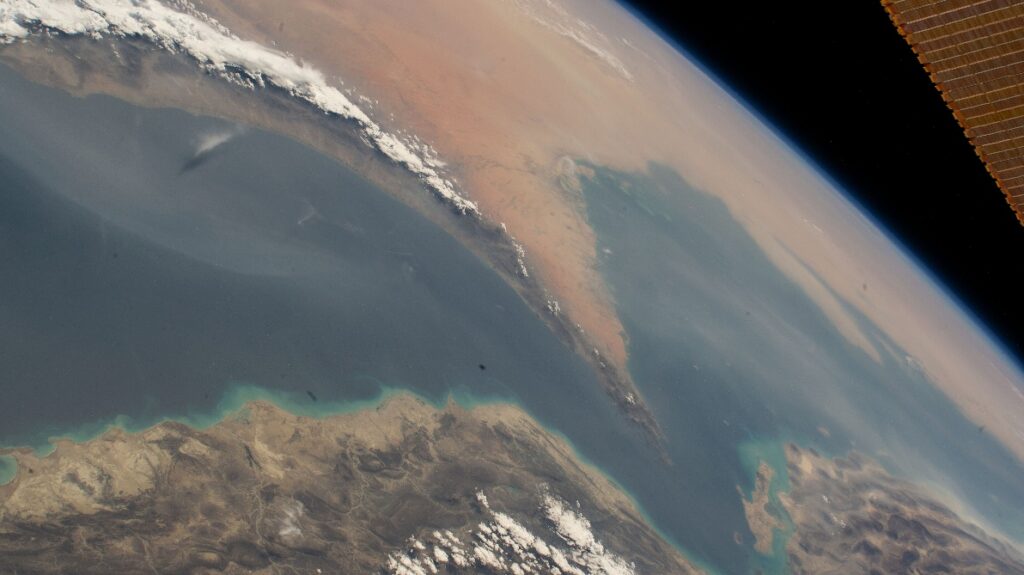
(The Strait of Hormuz, image courtesy of the National Air and Space Administration)
This heavenly – literally heavenly – view of the Strait of Hormuz is, like so many other pictures taken from space, a reminder of the beauty of our planet. At the same time, it misleads the viewer, obscuring the conflict that rages within and around it and the role that this apparently benign waterway is playing in the affairs of both people and nations.
In past issues of the newsletter, we urged that the question of war be brought before the Congress, the only body constitutionally able to declare such a condition, particularly in a case where the United States is the aggressor and not the victim. The administration has ignored this and has proceeded on a course of reckless destruction, only to discover that it lacks the power to bring Iran to heel. Subsequent efforts by Congress to pass a new War Powers Resolution have not succeeded in attracting a majority of the members and have therefore failed.
The consequences of the conflict have been staggering. To note just a few of them:
-A waterway that normally carries 20% of the world’s shipments of oil has effectively been closed by Iran, and now also by the counter-blockade instituted by the United States.
-The immediate result of the forced cessation of shipping traffic is a major reduction in the supply of petroleum to many countries in need of the energy it generates and the products derived from it.
-Because the oil market is essentially one big worldwide market the constriction of supply has raised the cost of oil and oil-based products across the globe. Everyone is paying more for those products, even Americans, notwithstanding that the United States is a net producer of petroleum and regards it as a major export.
-The resulting increase in gasoline prices has hit the budgets of every driver in our country. For the truck driver, the staggering cost of a gallon of diesel fuel is threatening to put many out of business.
-Where the higher price of fuel can somehow be borne by shippers, that cost is passed on to both the immediate and end users of the products – from raw materials to finished goods. Consumers are suddenly confronted with expenses that they did not anticipate. Manufacturers of products raise the prices of their manufactures, an additional cost that is again passed on to consumers.
-Inflation has thus been re-triggered and is impacting the entire world economy. Ironically, the winners in this stilted situation include our principal enemy, Russia, which, not being dependent on shipping the through the strait, now gets to sell its own oil production to needy nations at a premium.
-Meanwhile, having extravagantly expended limited stocks of weaponry – both defensive missiles like the Patriot System and offensive missiles like the Tomahawk, the United States has seen a reduction of its own long-term military resources. Those sophisticated armaments will be expensive to manufacture on the now-projected urgent basis, and it will take a long time to complete the anticipated orders.
-In the interim, our capacity to face down an aggressive China and to support a Ukraine that remains under Russian attack has at least partially been compromised.
-Partly because of this, and partly just because the President and the Secrtary of Defense appear hell-bent to create a massive war machine for future use, the Trump administration has sought billions in immediate defense appropriations and a gigantic half trillion – that’s trillion, with a “T” – dollar increase for the Defense Department for fiscal year 2026-2027.
*************
What, then, can be done to rein in the irresponsible conduct of the administration?
Happily, the courts, particularly the lower federal courts, have stood up to the abuses of the executive branch in a broad array of matters. For ordinary citizens, though, our primary remedy must be found in Congress. This is particularly so given that the courts usually defer to the other branches of government in matters of war and national security. So, it is ultimately upon Congress, with its power to declare war and power of the purse. upon which we must rely.
Regrettably, for the last year and one-half, the Article One branch has been anything but reliable. Congress has been complacent at best and complicit at worst in dealing with the actions of the Executive Branch, including its institution of the current war. This is why Senior Citizens for America is so heavily focused on the Congress, both in the immediate future and the longer term.
The Congress of today needs to be pressed to change its present views. The Congress of tomorrow needs to be transformed through a change in the balance of power.
For today, we have the power to lobby, petition for the redress of grievances, and assemble peaceably to make our voices heard. Individual communications to our representatives and rallies like No Kings Day 3 are the critical indicated actions. For tomorrow, we have the ballot box. Here is our true power. Seniors turn out to vote in greater percentages than any other demographic. Voting is our “secret sauce”, and we will need to use it in November.
Indeed, each of the 1,800 of us subscribers needs to communicate the same message to our children and grandchildren. (Spoiler alert: This will be among the suggestions we will soon be making of ways that you can join in “protecting democracy in an authoritarian time”.)
In the case of the Iran War, the immediate need is for Congress to reengage, taking the lead back from the administration in defining the goals of the Iran conflict and the funding that will be made available for its completion. Accordingly, we urge you to urge your representatives and Senators to support two things:
- new war powers legislation, and
- fiscal measures and budgetary appropriations tailored so as to adequately cover the nation’s true defense needs without taking us down the insane rabbit hole of providing everything the administration is asking for.
It will take doggedness and courage on their part. The members who have these qualities will deserve our thanks, and our financial contributions, too.
***
While only incidentally related to the crisis in the Persian Gulf, serious structural and personnel damage has contemporaneously been done by this administration to our armed services and other institutions responsible for our national security. We will detail this later in the year in The Iran War – Part II.